


Which coat can cover a merino sweater, a fine-gauge cardigan, and the occasional office blazer without making your shoulders look crowded? The answer is a clean wool coat with enough ease through the chest, a smooth lining, and a hem that works with trousers and skirts. January shopping rewards restraint: one dependable coat usually earns more wears than three trend pieces that fight with every knit in your wardrobe. This is not financial advice, but the same rule applies to clothing budgets: compare the real cost, fabric, fit, care, and likely wear count before you buy.
What should a January coat do over office knits?
The coat needs to solve a volume problem
Office knitwear creates more bulk than its slim appearance suggests. A ribbed turtleneck has raised seams. A cardigan adds buttons and a second front edge. A blazer brings structured shoulders. Put all three under a narrow coat and the result is pulling at the armholes, crushed lapels, and sleeves that ride up when you reach for a train pole.
The coat’s basic job is to create a smooth outer shell around those layers. That means a straight or gently shaped body, a sleeve wide enough for a sweater cuff, and a closure that does not strain across the bust. You do not need a huge oversized coat. You need controlled ease in the places that move.
The strongest capsule shape is a mid-thigh single-breasted coat
Mid-thigh length is the most useful starting point for January office dressing. It covers a blouse or knit dress, works with wide-leg trousers, and avoids the visual break created by a short jacket over a long cardigan. A single-breasted front also leaves less fabric across the torso than a double-breasted design.
Choose charcoal, navy, camel, or black before buying a bright seasonal color. These shades make a small wardrobe look larger because the coat can repeat with denim, tailoring, knit dresses, and work shoes. The verdict is simple: buy for clean coverage first, warmth second, and drama third.
How do you measure a coat for knitwear without guesswork?
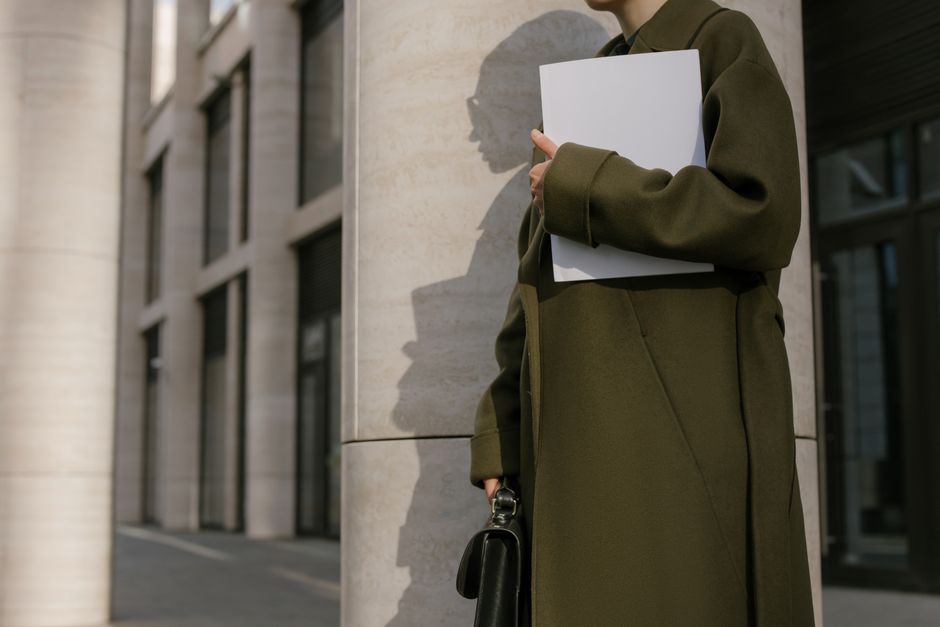
Use the largest layer as your fitting test
- Put on the thickest outfit you expect to wear under the coat: usually a medium-weight sweater, a blouse, and a blazer or cardigan.
- Measure around the fullest part of your chest while wearing that outfit. Keep the tape level and do not pull it tight.
- Compare that number with the garment’s finished chest measurement, not only the body-size chart. Aim for roughly 4 to 6 inches of total ease for a polished coat that still allows movement.
- Check the shoulder seam. It can sit slightly beyond your natural shoulder on a relaxed coat, but it should not drop so far that the sleeve twists.
- Raise both arms, cross them in front of your body, and sit down. If the coat pulls across the back or lifts sharply at the hem, it is too small for your real wardrobe.
Check the sleeve and hem against your work clothes
A sleeve ending at the wrist can expose a sweater cuff to rain and road salt. Look for a sleeve that reaches the wrist bone or slightly below it when your arms hang naturally. If you wear blazers, the coat sleeve should still cover the jacket sleeve by at least half an inch.
For the hem, stand in the trousers and skirts you wear most often. A coat that ends at the widest point of your calf can make the lower half look heavy, while a hem just below the knee or around mid-thigh tends to work across more outfits. The largest knit in your closet should pass the movement test before you trust the size chart. That is the practical verdict: fit the coat to your most demanding outfit, not the thin top you happen to be wearing while shopping.
Which January capsule coats are worth the money in 2026?

Best value is not the same as the lowest ticket price. A useful coat should combine a credible fiber content, a lining that lets knitwear slide, a return policy you can actually use, and enough room for your winter layers.
Pick the J.Crew for a polished office uniform
The J.Crew Daphne is the strongest choice when your January wardrobe includes trousers, button-down shirts, and fine merino sweaters. Its topcoat shape reads more tailored than a cocoon coat, while the boiled-wool fabric gives it enough body to sit over knitwear without collapsing.
Pick Quince for warmth per dollar
The Quince Italian Wool Cocoon Coat makes more sense for a cold commute or a wardrobe built around thicker sweaters. Its 80/20 wool-nylon blend and stated low-temperature rating make the specifications clearer than a vague “winter weight” claim. The tradeoff is shape: the cocoon volume looks best with straight-leg or slim trousers. The UNIQLO coat is the budget pick for mild winter days, but it should not be treated as a substitute for a heavily insulated parka.
What coat mistakes make office layering look messy?
Why does the coat pull across the back?
The usual cause is not a bad sweater. It is insufficient ease across the upper back or a sleeve angle that fights your arm position. A coat can fit at the bust and still fail when you drive, type, or carry a laptop. Try those movements before removing the tags. If the lining catches on fuzzy knitwear, the problem may be fabric friction rather than size, and a smoother lining is the better fix.
When should you skip a wool coat?
Skip a standard wool coat if your commute involves long waits in heavy rain, frequent cycling, or very cold exposure without indoor breaks. Wool handles light moisture well, but it is not a waterproof shell. In those cases, buy a weatherproof outer layer and keep the wool coat for office-to-dinner use. Also skip a pale camel coat if you cannot tolerate regular collar cleaning; foundation, hair oil, and transit grime show quickly at the neckline.
How should you control the total purchase cost?
Calculate the price after alterations, dry cleaning, shipping, and return fees. Pay in full unless the terms are clear and the purchase already fits your budget. This is not financial advice; it is a reminder that financing can erase a clothing discount quickly.
The clear verdict is to avoid a coat that requires constant correction. Pulling, pilling, exposed cuffs, and awkward movement are not minor annoyances in a daily January layer. They are signs that the garment does not fit the job.
What is the final January coat verdict for office knitwear?

Buy one coat before building a larger capsule
My pick is the J.Crew Daphne topcoat for a polished office wardrobe, the Quince Italian Wool Cocoon Coat for colder commutes and thicker knits, and the UNIQLO Double Face Relaxed Long Coat for a lower-cost starter capsule. The J.Crew has the cleanest tailored line. Quince offers the strongest warmth-to-price case.
Use the three-outfit test before keeping it
Wear the coat over your thinnest merino sweater, your largest office cardigan, and a blazer. Pair it with trousers, a straight skirt, and your usual winter shoes. The right coat should close without strain, leave room at the armholes, and keep the outfit’s proportions calm. If it works in all three combinations, it has earned capsule status. If it only looks good over a thin top in a mirror, return it.
That is the resolution to the January morning problem: choose a mid-thigh coat with real movement room, a smooth finish, and a color that repeats across your closet. Your office knit can stay warm underneath, your shoulders can move normally, and the coat can do its quiet job instead of becoming the problem.